Causal determinism, in a basic interpretation, is the concept in which all facts of the past pair with the laws of nature in order to determine the future. Suppose, for example, an individual who failed an exam. This would be caused by a fact such as their lack of preparation, which could be a product of their character. This character may be influenced by other factors such as the people they grew up around, along with other general circumstances. These factors would all contribute and determine the event of the individual failing this exam. One could thus reasonably state that all provided past facts, along with the laws of nature, determine the present and the future.
This could theoretically be modelled through combinatorics, the exploration of quantities that are on some scales, conventionally incomputable. A simplified example would be if an individual had 5 shirts, 6 pairs of pants, and 7 ties, they would have N total outfits. This could be modelled by

where an individual could find the total possibilities of shirts, pants, or ties. Determinism is in some ways expressible throughout human history in the same structure by saying that perhaps every separate event leading up to a time t did or did not happen. Further, it could be constructed that each event has more than one outcome, rather than true or false, in the same way that if a coin is flipped, it also produces either heads or tails. Similarly, a die being rolled can produce any value from 1-6. Suppose now the following statement:
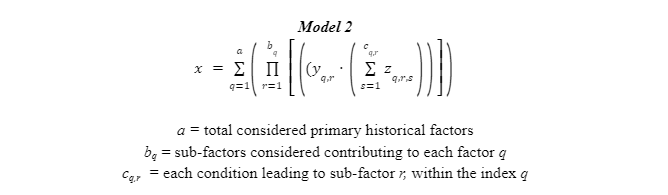
This is a conceptual construct that can convey the nature of any cultural artefact, for example, W. E. B. Du Bois’s The Comet. Let x be the artefact, which is the summation () of primary factors, such as historical conditions at the time. Some examples would be the socio-economic status of Black Americans at the time, as well as interpersonal relationships, literary influences, and education, with respect to Du Bois. This summation of q would iterate through each factor, from the first until the a-th. Then, the inner product (∏) would serve a similar function to collecting the product of all the shirts, ties, and pants, but iterates through historical factors of a more “micro scale,” or those contributed to the most direct conditions listed under the outside sum.
Y represents any of these sub-factors at position r under the q-th outside historical condition. Something that would contribute to the social status of Black Americans at the time would be the Jim Crow laws, and Du Bois’s education at Harvard. The inner summation () processes each condition that affects those sub-factors, which are what y denotes.
At this point, consider a condition affecting the sub-factor “Jim Crow laws,” which impacts the socio-economic status of Black Americans around the period 1920. In this scenario, imagine that the socio-economic status is at index 1 of impact, and the Jim Crow laws are also at the forefront index 1 for impact to the social environment. To assess, say, the fifth condition to impact the Jim Crow laws of z would be z1,1,5, substituting the q, r, and s index values respectively. Variable z would now be a characteristic of history such as the antebellum political dynamics of Southern states.
Using Model 2, one could approach any cultural artefact with an analytical method. However, it must be kept in mind that this model is realistically a concept, which would require expansion with the same structure of summation of the products of sums to a further indexed degree, as each condition may be impacted by non-evaluable quantities of factors. Therefore, this remains a theoretical construct, feasible only for a computer. However, when considering details such as improving artificial intelligence models and the expansion of computational power into the future, models such as these move from literal infeasibility towards potential reality. This current that pulls humanity towards the future holds concerning implications for the future. Should the metaphysical property of determinism hold, the future possesses insight into the further future, as well as allow one to better understand how other human and nonhuman minds perceive human culture.
