Make screen shots or somehow capture two images from 7 Miles a Second—one that you see as utopian and the other that you see as dystopian.
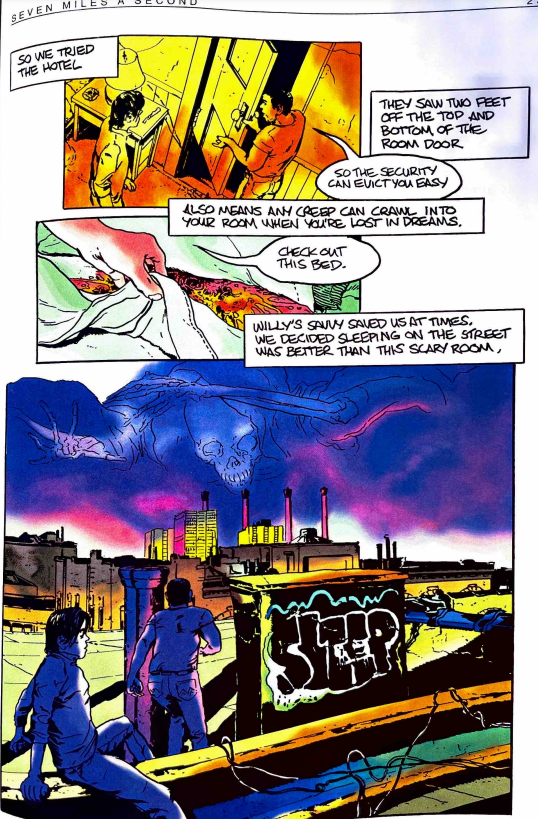
This panel from David Wojnarowicz’s Seven Miles a Second captured many dystopian elements of the graphic novel. The sawed door is an invasive practice in this society that reflects a lack of safety and privacy, even ‘behind closed doors’. This is contrasted with the fact that they ultimately chose to sleep outside with exposure to the elements over the conditions presented by the hotel. Sleeping on the street is also contrasted with the poor hygiene shown in the second panel where David pulls back the sheets to reveal some sort of discoloured splotches. As an element of dystopian society, the amount of ‘attention’ paid to the value of privacy versus the value of cleanliness places the priorities on surveillance and control over providing a service.
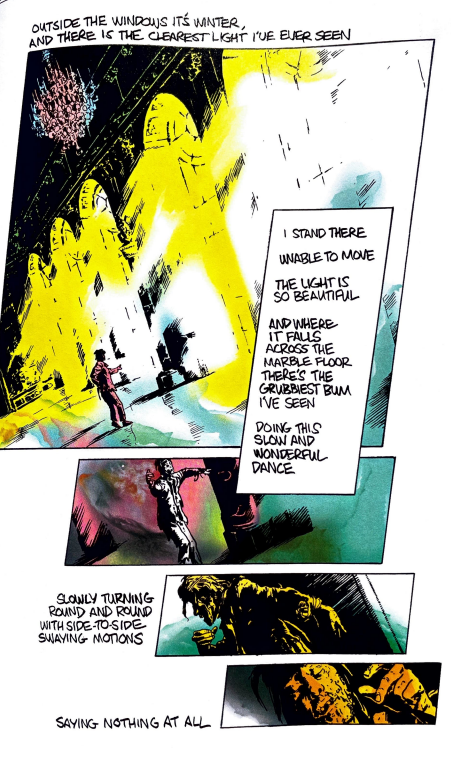
On the other hand, this panel seems far more utopian. At this point in the narrative, David is asleep and dreaming. Utopia is often well-represented in dreams because the dreamer has the ability to imagine differently in spite of their body being subject to dystopian conditions. Here, even when compared in colour, this panel starts off with light and bright colours, with much less dirt and open architecture. Within the last three panels, the bum’s dance may be seen as this man’s hope in spite of his conditions. When placed in the context of the preceding page, David’s dream includes him walking up a hall, to the chamber with the bum. On the walk to the chamber, David sees people sleeping outside who have neither a home nor money. One could interpret this as a waiting queue for the larger ‘mansion,’ which seems hopeful or optimistic.